The Ecclesiastical Pickle
If you’ve been following along, you know that my resignation from ordained ministry in the ACNA back in November 2023 turned into something of an ecclesiastical pickle earlier this year.
The short version: I had resigned from the ACNA while explicitly stating that I was not renouncing my Holy Orders. My bishop at the time, Todd Hunter, gave me a letter confirming my good standing and my request “to resign from ministerial duties while remaining in Holy Orders.” But when Bishop Todd began preparing for retirement, he reached out to clarify whether that framing was canonically correct. His successor, Bishop Jeff Bailey, had questions.
The question at stake was whether the ACNA Canons distinguish between resigning from ordained ministry in the ACNA (a jurisdictional release) and renouncing Holy Orders as such (something more like an ontological claim). I believed they did. The “in this Church” language in the canons seemed significant to me. The ACNA leadership, it turns out, sees it differently.
Letters Dimissory Received
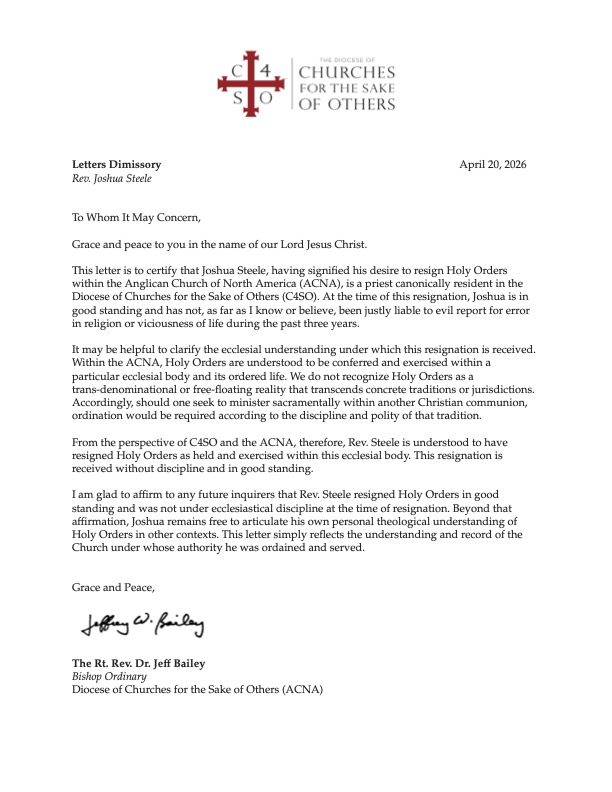
After several months of conversation, I’ve now received a formal Letters Dimissory from Bishop Jeff Bailey. You can read the full letter here:
And, for reference, here’s the November 2023 letter from Bishop Todd Hunter after I tendered my resignation, according to ACNA Canon III.6, effective on 2023-11-01:
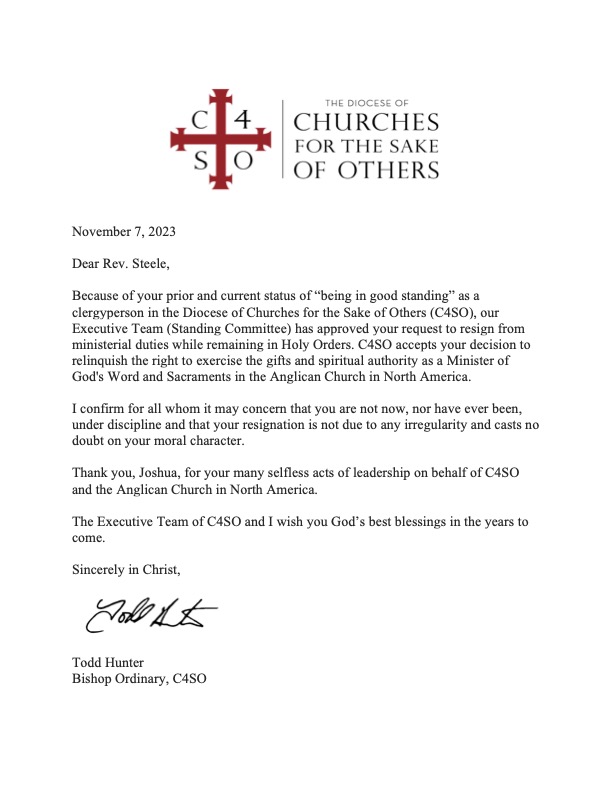
Both letters confirm what matters most to me practically: I resigned in good standing, without discipline, and my departure casts no doubt on my moral character. Bishop Jeff has indicated he’s willing to affirm this to any future inquirers.
The most recent letter also makes clear where we see things differently. Bishop Jeff writes:
Within the ACNA, Holy Orders are understood to be conferred and exercised within a particular ecclesial body and its ordered life. We do not recognize Holy Orders as a trans-denominational or free-floating reality that transcends concrete traditions or jurisdictions.
From the ACNA’s perspective, I have resigned Holy Orders. Full stop.
I do not think this understanding of Holy Orders matches what the ACNA Constitution and Canons say. The canonical case for distinguishing voluntary resignation from renunciation of Holy Orders rests on several features of ACNA Title III:
- Canon III.6.3.1 uses “in this Church” language throughout. What a resigning cleric relinquishes is “the right to exercise in this Church the gifts and spiritual authority… conferred in ordination,” not the gifts themselves.
- Canon III.6.4 provides that a resigned cleric may petition to “restore the right to exercise” gifts “conferred in ordination.” The canon assumes the underlying ordination persists; no re-ordination is required. The parallel processes for bishops (III.8.9.4) and for inter-diocesan transfer (III.6.1-2) likewise contemplate return or transfer without re-ordination.
- Canon III.5.3.1 provides that clergy from other bodies in the historic succession are received “in the Orders to which already ordained,” with conditional ordination only where the ordaining bishop’s authority is not recognized. The canons therefore presuppose that Holy Orders exist across jurisdictions.
I’m grateful to Bill Barto, a canon lawyer and priest in the Reformed Episcopal Church, for sharpening several of these points in correspondence. Check out his Substack, “The Optimistic Jurist.”
But the letter also acknowledges that I’m “free to articulate [my] own personal theological understanding of Holy Orders in other contexts.”
So, am I still a priest?
Honestly, I go back and forth.
Some days I read the Ordinal and it sounds unmistakably ontological.
“Receive the Holy Spirit for the office and work of a Priest in the Church of God, now committed to you by the imposition of our hands.”
That is not the language of authorization. It sounds like a gift being given, a reality being created. The anointing of my hands, with the prayer that “whatsoever they bless may be blessed, and whatsoever they consecrate may be consecrated and sanctified,” comes almost word for word from the Roman pontifical. It is Catholic language about Catholic realities, prayed over me by Anglicans who meant something by it.
Paul tells Timothy to “rekindle the gift of God that is in you through the laying on of my hands” (2 Tim 1:6), and the gift seems to be something Timothy now carries, not a license he holds. If something like that was given to me, I cannot see how a canonical process revokes it.
Other days I find the Reformed or functional view more honest.
Maybe I am over-reading the ceremony. The ACNA’s own canons describe ordination as service “in this Church,” and Bishop Jeff’s letter is consistent with that framing. On this view, ordination is the church’s public setting apart of a person for ministry within a particular community, and when the relationship to that community ends, so does the office.
There is something attractive about refusing to treat ordination as magic. The ministry belongs to the whole church, not to ordained individuals as personal property. Maybe the “residue” I feel is nostalgia, or pride, or simply formation that runs deep.
I go back and forth. I have not settled this, and I may not settle it.
What I can say is that something was done when hands were laid on me. Whether that something is indelible or revocable, ontological or merely functional, trans-denominational or ecclesially bound, I genuinely do not know. The language of my ordination pulls me one way. The polity under which I was ordained, at least as currently interpreted, pulls the other. I am content, for now, to hold the question open rather than pretend I have resolved it.
For what it’s worth, Richard Hooker, the great 16th-century Anglican theologian, viewed ordination as having an indelible mark/character. Hooker wrote the following in his Of the Laws of Ecclesiastical Polity (V.77.3):
They which have once received this power may not think to put it off and on like a cloak as the weather serveth, to take it reject and resume it as oft as themselves list, of which profane and impious contempt these later times have yielded as of all other kinds of iniquity and apostasy strange examples; but let them know which put their hands unto this plough, that once consecrated unto God they are made his peculiar inheritance for ever. Suspensions may stop, and degradations utterly cut off the use or exercise of power before given: but voluntarily it is not in the power of man to separate and pull asunder what God by his authority coupleth. So that although there may be through misdesert degradation as there may be cause of just separation after matrimony, yet if (as sometime it doth) restitution to former dignity or reconciliation after breach doth happen, neither doth the one nor the other ever iterate the first knot.
A few questions I’d love feedback on
If you have theological chops and time, I’d be grateful for your help thinking through this. A few questions, aimed at different readers:
For Anglican readers of any stripe (ACNA, TEC, CoE, Continuing, formerly Anglican): how do you read the Ordinal? Does the language of the rite imply something ontological, or is that reading too much into what is essentially liturgical speech? How do you understand the relationship between the rite and the canons?
For Reformed and Baptist readers: how do you understand passages like 2 Timothy 1:6, where Paul speaks of a gift given through the laying on of hands? Is that gift tied to the specific ministry context Timothy was in, or something more durable? And if ordination is the church’s recognition of a divine call, what happens to the call when the ecclesial context changes?
For Catholic and Orthodox readers: given that my ordination was within a body claiming apostolic succession, but one that now tells me Holy Orders are bound to that body alone, how would your tradition frame someone in my position? Is this a case where the external forum and internal forum are just going to say different things?
For Lutheran readers, especially those formed by Jenson or the broader evangelical catholic stream: what do you make of the tension between Luther’s insistence that the ministry is a real gift of the Spirit, and the Reformation’s refusal to call ordination a sacrament in the strict sense?
And for anyone who has made a similar transition out of ordained ministry: what theology of ordination did you end up with, and how did you arrive there? I would especially love to hear from people who have thought about this over years rather than months.
I am not asking anyone to settle the question for me. I am asking to be helped to think about it more clearly.
Conclusion
The institutional piece is now resolved. The documentation is clean, my standing is clear, and the uncertainty of the past two and a half years is behind me. The theological questions are still open, but I can now hold them without the canonical ambiguity muddying the water.
I’m grateful to both Bishop Todd and Bishop Jeff for handling this pastorally. Todd gave me a framework that let me leave with my conscience intact. Jeff formalized that departure in a way that respects both the ACNA’s self-understanding and my freedom to hold my own.